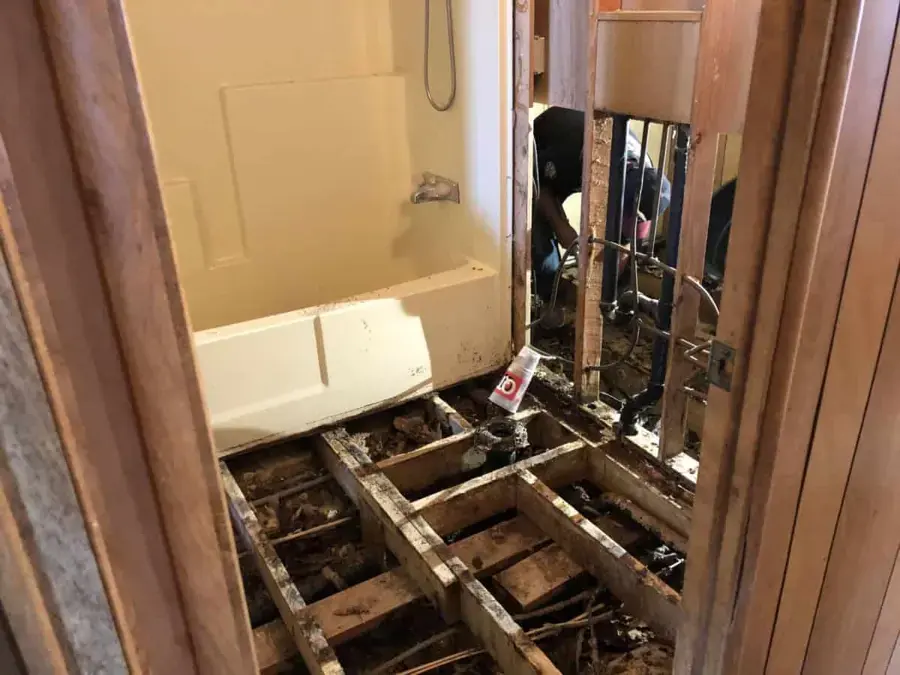
When Bear Creek rises, the first homes to feel it are often manufactured homes in the parks along its banks. The creek gauge in Medford tells how close the water is.
Key takeaways
- The NWS gauge Bear Creek at Medford has a flood stage of 10 feet, and at that stage water begins to enter mobile home parks from Talent to Medford.
- At 13 feet, mobile home parks are flooded and water is over the Barnett Street bridge.
- The January 1, 1997 flood damaged about 1,200 homes in Jackson County, most of them mobile or manufactured homes.
- At Medford Mobile Estates, water rose 3.5 feet in 30 minutes, so there may be very little time to react.
- Creek floodwater is treated as contaminated from the first step, and everything it touches is assessed, not just wiped.
What the Bear Creek gauge tells a park resident
Bear Creek runs through Medford, and the National Weather Service keeps a gauge on it called Bear Creek at Medford. The gauge reading is a number in feet, and it has a meaning for the people who live nearby.
At 10 feet the creek reaches flood stage. At that stage, water begins to enter mobile home parks from Talent to Medford.
At 13 feet the picture changes. Mobile home parks are flooded and water is over the Barnett Street bridge.
Those two numbers give a park resident something concrete to watch. They turn a vague worry about a wet winter into a clear point for moving cars, papers and keepsakes.
- 10 feet: Flood stage. Water starts to enter mobile home parks.
- 13 feet: Parks are flooded and water covers the Barnett Street bridge.
- Rising fast: A creek can climb quickly, so watching the gauge early matters more than watching it late.
What the January 1997 flood showed
The January 1, 1997 Bear Creek flood damaged about 1,200 homes in Jackson County. Most of them were mobile or manufactured homes.
The City of Medford says 8.5 inches of rain fell in less than three days. It describes the storm as a 30 year storm event.
At Medford Mobile Estates near Bear Creek, water rose 3.5 feet in 30 minutes. That speed is the part that stays with people, because it left little time to move belongings or vehicles.
Why manufactured homes are hit first
A manufactured home sits close to the ground, and the floor system is thin. The belly insulation and the decking take the water first.
Medford has 1,253 mobile homes, and parks along creek corridors are the places where flood stage matters most.
Which creeks flood in Medford
Bear Creek is not the only water to watch. The City of Medford names Bear Creek and its tributaries Lazy Creek, Larson Creek, Crooked Creek and Lone Pine Creek as the flooding streams.
About 4.5 percent of the city's land area is in the 1 percent annual chance floodplain, also called the 100 year floodplain.
A home outside that area can still be hit by runoff, but the gauge and the floodplain are the two best starting points for a risk check.
Residents of a park along a creek corridor can ask the park manager which part of the park sits lowest, because that is where water arrives first.
What floodwater does inside a manufactured home
Creek water does not behave like water from a broken pipe. It carries silt and whatever it picked up on the way, and it is handled as Category 3, the most contaminated class.
That means porous materials that floodwater touches, such as insulation, carpet pad and soft decking, are usually removed instead of dried.
- Belly insulation: Soaked insulation is pulled out because it cannot be cleaned.
- Decking: Particleboard swells and loses strength, and it may need to be replaced.
- Carpet and pad: Pad is removed, and carpet is judged case by case.
- Walls and trim: The lower section is opened so the cavity can be cleaned and dried.
- Ductwork under the floor: Water that reached the ducts has to be dealt with before the system runs again.

How the cleanup works
A flood water cleanup starts with safety. Power is checked, the water is removed and the wet materials are sorted into what can be saved and what cannot.
For homes on a creek corridor, the extraction step usually comes first, because every hour of standing water lets more of it soak into the floor system.
Pumps and wet vacuums pull the water out, and then the crew checks what the water reached. A floor that looks fine on top can be soaked below, so the check goes under the decking too.
The work is documented with photos and moisture readings, which makes the insurance side easier to handle.
Manufactured home steps
The page on manufactured home water damage in Medford covers the belly in more detail. It is opened, the wet insulation is taken out and the decking is dried or replaced.
Air movers and dehumidifiers then run until readings in the frame match a dry reference.
Cleaning after the water leaves
Once the structure is dry, surfaces that floodwater touched are cleaned and treated. Skipping this step is a common mistake after a creek flood.
The goal is a home that is dry, clean and ready for the repair work that follows.
What to do before and after the creek rises
Some steps make sense before the creek is high, and some only after. Both lists are short.
- Watch the gauge: Check Bear Creek at Medford during heavy rain, and treat 10 feet as the point to start moving belongings.
- Move vehicles and valuables early: Water can rise 3.5 feet in minutes, as it did in 1997.
- Stay out of floodwater: It is contaminated and may hide debris and electrical hazards.
- Photograph everything: Pictures of the high water mark, the belly and the floors help with a claim.
- Call for cleanup quickly: The longer the floor system stays wet, the more of it has to be replaced.
Where this connects to the wider region
Flooding is a regional concern, and the same type of cleanup applies across the Rogue Valley. The main page for flood water cleanup in Grants Pass shows how the process works for river and creek water there.
The Medford service hub lists every cleanup type available for homes and businesses in the city.