When water is leaking at an Eagle Point property, the first question is not how bad it is. It is which side of the water meter the leak is on.
Key takeaways
- The City of Eagle Point water department delivers water supplied by the Medford Water Commission.
- If a leak is on the city side of the water meter, the City of Eagle Point fixes it at no charge.
- If the leak is on the customer side, the property owner is responsible for the repair.
- Either way, water that has already entered a house or a crawl space still needs to be removed and dried.
- A wet yard, a spinning meter with every tap off and a sudden jump in the bill all point to a leak worth tracing.
How water reaches an Eagle Point home
The City of Eagle Point water department delivers the water, and the water itself is supplied by the Medford Water Commission. Eagle Point, Jacksonville, Phoenix, Talent, Ashland and White City share Medford Water's sources.
The primary source is Big Butte Springs, a groundwater supply from the lower slopes of Mt. McLoughlin. The secondary source is the Rogue River.
Between the city main and the faucet inside a house sits a water meter. That meter is the dividing point for who is responsible for a leak.
The rule that decides who fixes the leak
The City of Eagle Point has a simple rule. If a leak is on the city side of the water meter, the city fixes it at no charge.
If the leak is on the customer side, meaning the pipe between the meter and the house or inside the house, the property owner is responsible.
Eagle Point reports possible water leaks through its water department, and after hours, water breaks go to dispatch. That is the right first call when a leak is outside the house and near the street.
A leak inside the house is a different call, because the city does not repair pipes on the customer side.
- City side: The pipe from the main up to the meter. The city repairs it.
- Customer side: The pipe from the meter to the house, and every pipe inside. The owner repairs it.
- Unsure: A leak right at the meter can be hard to place, so the city can confirm which side it is on.
Signs of a leak before water shows up
Many leaks reveal themselves in numbers and in the ground. Neither one needs a plumber to notice.
- A moving meter: With every tap and appliance off, the meter dial still turns.
- A jump in the water bill: A sudden rise without a change in habits points to a leak.
- A wet or soft spot in the yard: Water pooling near the meter or along the pipe route is a strong clue.
- Low pressure: A leak lowers the pressure available at the taps.
- A hiss or a running sound: Water moving in a pipe makes noise when nothing is on.
A quick meter test
Turn off every tap, the dishwasher and the washer. Look at the meter and note the dial or the small leak indicator.
Wait an hour without using water, then look again. If the dial moved, water is escaping somewhere on the customer side or the city side.
When the leak is on the customer side
Eagle Point has a mix of homes. About 31.9 percent were built from 2000 to 2009 and about 21.0 percent from 1990 to 1999, and the median build year is 2000. Another 391 were built before 1960.
Supply pipes in houses of those ages are decades old, so a leak under a slab, in a wall or in a crawl space is plausible.
Nobody can name the pipe material without looking, so a plumber's inspection is the right first step.
What the owner does first
Close the main shutoff at the house and open a tap to relieve pressure. If the leak is outside, closing the valve at the meter can also stop it, as long as it can be reached.
Then call a plumber for the repair and note the time the leak was found.
What happens to the water in the house
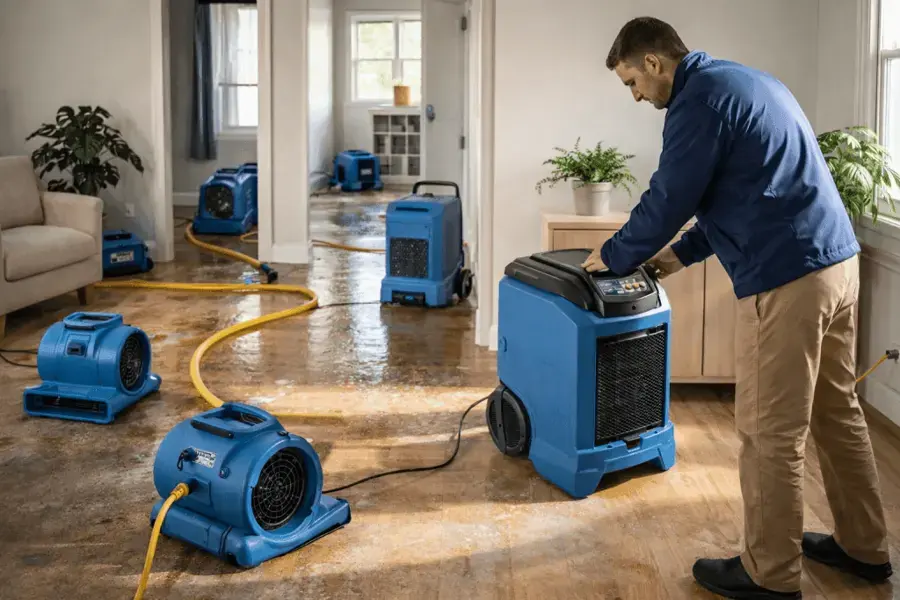
A burst pipe cleanup covers what the plumber does not: the wet floor, wall or ceiling. The wet cavity is opened, the water is removed and the framing is dried.
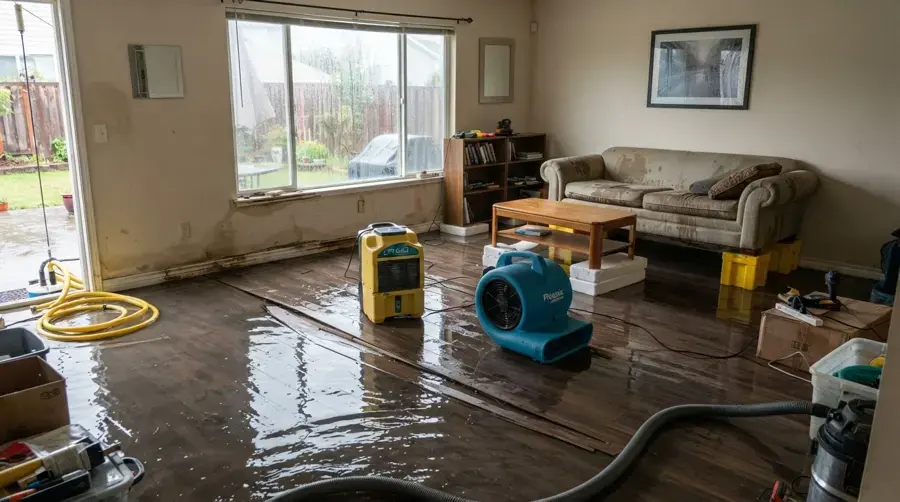
For standing water, water extraction comes first, because a floor that stays wet for a day or two begins to swell.
When the leak is on the city side
A city side leak usually shows outside, near the meter or the street. Water may bubble up through a lawn or a driveway, or it may run along the curb.
The city fixes the pipe at no charge, but it does not dry a house. If the water has traveled toward the foundation or into a crawl space, cleanup is a separate job.
That is why a photo of the source, the meter reading and the time of the call are all worth keeping.
Why drying cannot wait for the repair
A repair stops the water, but it does not remove what has already soaked in. Wood, drywall and insulation keep that water until it is taken out.
The Eagle Point service hub lists every type of cleanup for homes and businesses in the city, from pipe leaks to flood water.
The wait between the leak and the cleanup is the part a homeowner controls. Calling early keeps the damage small.
The same logic applies in nearby cities. The page on burst pipe cleanup in Grants Pass shows how a pipe failure is handled from the shutoff to the final readings.
In every case the order is the same: stop the water, remove what soaked in, dry the structure and record the readings.
A checklist for the first hour
These steps work for either side of the meter.
- Note the time: Write down when the leak was found and what the meter read.
- Shut the valve: Close the main at the house, or at the meter if it is safely reachable.
- Take photos: The wet area, the meter and the source, before anything is moved.
- Move belongings: Lift items off wet floors and away from walls.
- Make the right calls: The city for a city side leak, a plumber for the customer side, and cleanup for the wet house.